
Melting Denial
And trying not to flood

I’m walking on water.
That’s what I kept thinking when I was on the Greenland ice sheet years ago with a team of scientists from the University of Montana1. For most of a week, we walked, worked, cooked, ate, and slept on a massive slab of precious, drinkable, fresh water. A mountain of it, thousands of feet thick.
The ice sheet is a surreal, desert-like waterworld. When you depart from the edge, you leave rocks, soil, trees, and anything that might grow or perch on them behind. Whatever land exists is buried far below, untouched by the Sun for hundreds of thousands of years. Theoretically, you’re still in the terrestrial realm, but water is the only substance and substrate. It is architecture and architect; everywhere you look, everything you touch, it’s all water, constantly making, melting, and remaking itself.
This shape-shifting follows an annual rhythm — even without human intervention in climactic processes, ice sheets grow and shrink with the seasons. But as we overheat the world, the shrinkage is winning.2 The ice sheet is being un-made faster than it can rebuild itself. On our helicopter ride in to the study site, we flew over ponds melting into lakes, lakes growing into freshwater seas. We walked from our lonely little circle of tents to the edges of gorgeous, deadly rivers carving twisting paths into the surface; indigo veins painted on the icebody, a new circulatory system birthing itself before our eyes. I dropped my microphone down into a crevasse and listened to this ancient structure groan, gurgle, and pop, the voice of a mighty creature transforming from solid into liquid.
The Greenland ice sheet holds around 10% of the world’s freshwater. Every second, the equivalent of three Olympic-sized swimming pools of that water are gushing into the sea.
All of this came to mind for me recently while talking to Kaveh Madani for Threshold Conversations. Kaveh is the director of the Institute for Water, Environment and Health at the UN University, and this year’s winner of the Stockholm Water Prize, considered the “Nobel Prize for water issues.” Iranian by birth and now living in exile, he’s trying to shake the world out of denial about how rapidly and dramatically we are depleting our fresh water resources. Here’s an excerpt from our conversation:
We cannot communicate to people that we are only in a crisis. Indeed, if we do that, we are sending a wrong signal to people that this is fixable, “spend more money, let’s approve one more project, let’s take out more water, let’s take more loans from nature and fix this problem.” But…the checking account is now empty. That’s our surface water that gets recharged by nature every year. The savings accounts that we inherited from our grandparents are also gone. Groundwater level is declining in many places. Glaciers are melting as well, so our reserves are very low. We have used not only the interest but also our principal. We have some assets still left….but we have to live with what we have. Not only do we need to mitigate what can be mitigated, but we also need to adapt to a new reality.
~ Kaveh Madani
I can feel my own internal resistance to really hearing what Kaveh is saying, and what he communicated in the Global Water Bankruptcy report published earlier this year. Our need for fresh water is so primal and raw; it’s scary to take in its scarcity. But as Kaveh said in our conversation, the worst thing you can do in a bankrupt situation is delay being honest about it. That’s how you end up drowning cities in one place and pushing people into drought and famine in another.
As with all of these huge ecological issues, I don’t know what I can do that’s useful, but the first step, as always, is just acknowledging reality. That’s where my time on the Greenland ice sheet is helpful, I guess: I could feel and hear and sense the loss there in a personal, tangible way. That mountain of fresh water I had the privilege of sleeping on for a week — it’s getting smaller and smaller. It cannot replenish itself because of our actions, and neither can many of the rivers, lakes, and aquifers we rely on to fill our taps and grow our food. We are “living beyond our hydrological means,” as Kaveh’s report puts it; spending down water resources that we cannot repay.
I lift a glass of clean water to my mouth, take a drink. Take a breath. Take it in.
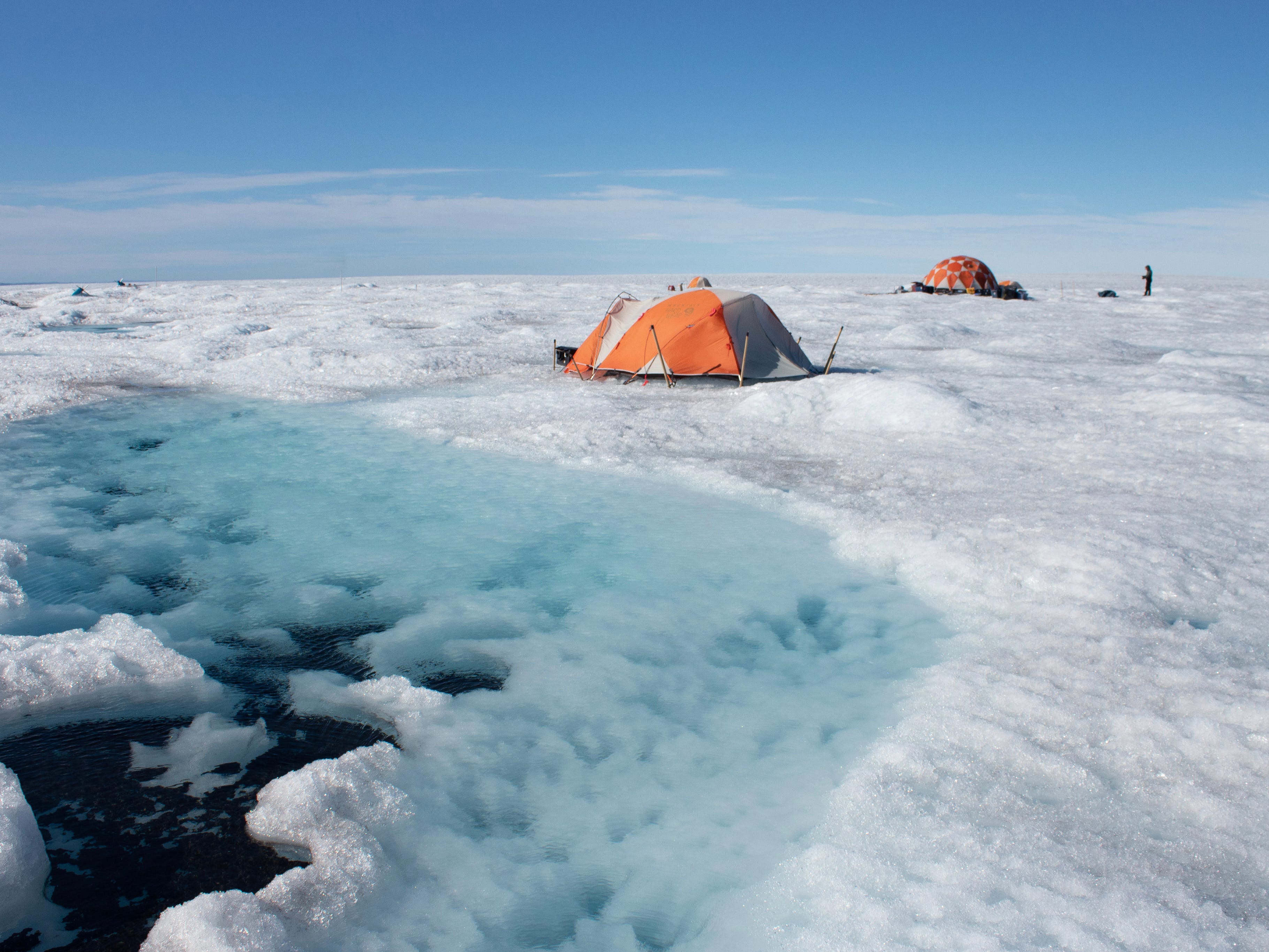
I’ll never stop being grateful to Joel Harper for allowing me to join his team on this expedition!
Here are three good sources for further information about changes in the Greenland ice sheet from the Copernicus Programme, the UN Regional Information Centre for Western Europe, and a recent paper published in Nature.